

How to Choose the Right Heel Height for Your Petite Frame
If you’re petite, you already know the heel struggle. Too flat and your legs look shorter. Too tall and you’re wobbling by hour two, tugging your hem down, wondering why nothing about the shoe feels like you. This heel height guide petite readers actually need isn’t about chasing the tallest stiletto in the store — it’s about finding the exact range that lengthens your frame without turning every outfit into an endurance test.
The good news: petite proportions respond fast to the right heel. A half-inch difference can change how long your leg reads, how your pants break at the ankle, even how a blazer hangs. There’s a sweet spot most petite women never test because they’re either avoiding heels entirely or grabbing whatever’s trending.
By the end of this guide, you’ll know your ideal heel range, which shapes elongate your leg line, and which styles to skip no matter how good they look on the shelf. This takes about 20 minutes with shoes you already own, plus a bit more if you’re shopping. No measuring tape gymnastics, no guesswork — just a system that works with your actual proportions.
Grab a few pairs of shoes from your closet (or a shopping trip planned) and let’s find your range.
- A soft measuring tape
- 3-4 pairs of shoes at different heel heights (or a shopping trip)
- A full-length mirror
- Your most-worn pants or hem length for reference
- Measure your inseam-to-height ratio
- Rule out anything under 2 inches
- Test the 3-3.5 inch sweet spot
- Match heel shape to your leg line
- Check the vamp height
- Try a kitten heel for elongation
- Save platforms for wide-leg pants
- Walk the aisle before buying
- Build a three-height wardrobe
Measure Your Inseam-to-Height Ratio First
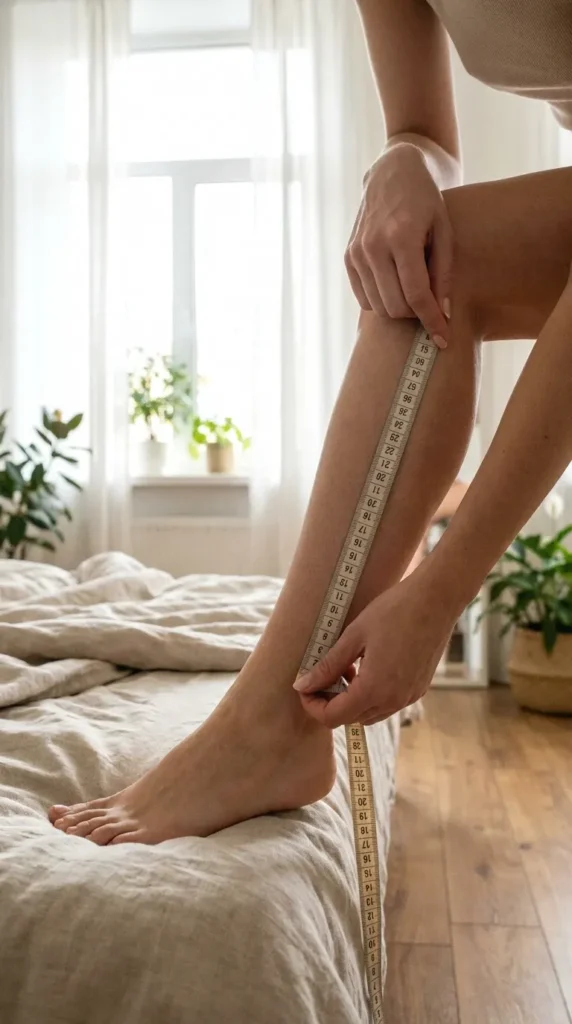
Grab your measuring tape and find your inseam — the distance from crotch to ankle bone. Divide that by your total height. Most petite frames land under 0.45, which means your legs make up less of your visible height than average. This isn’t a flaw to fix; it’s the number that tells you exactly how much lift actually helps versus how much just adds wobble. Write it down. You’ll compare it against every heel decision in this guide.
Rule Out Anything Under 2 Inches for Everyday Wear

A completely flat shoe or one under 2 inches does the opposite of what you want — it shortens the visible leg line instead of extending it. This surprises people, because flats feel “safer.” But zero lift means zero arch, and zero arch means your calf muscle never elongates the way it does in a slight heel. Keep flats for weekends. For anything you want to look put-together in, this is your floor, not your ceiling.
Test the 3-to-3.5 Inch Sweet Spot Range

This is the range that does the most work for petite proportions without punishing your feet by evening. 3 to 3.5 inches creates enough calf definition and ankle taper to visually stretch the leg, while staying low enough that your center of gravity doesn’t shift into “careful steps” territory. Put on a pair in this range and stand sideways in the mirror. Watch where your ankle bone sits relative to the hem of your pants — that’s the elongation effect working.
Match Heel Shape to Your Leg Line

A thin stiletto or slim block heel continues the line of your leg down to the floor, while a thick chunky heel interrupts it visually and adds width where you don’t need it. Stand in front of the mirror in two different shapes and compare — the difference is sharper than most people expect. If chunky heels are more your comfort zone, look for tapered versions that narrow slightly at the base instead of staying full-width all the way down.
Rounded toes shorten the leg line further, so pointed or almond toes pair best with your 3-3.5 inch range.
Check the Vamp Height, Not Just the Heel
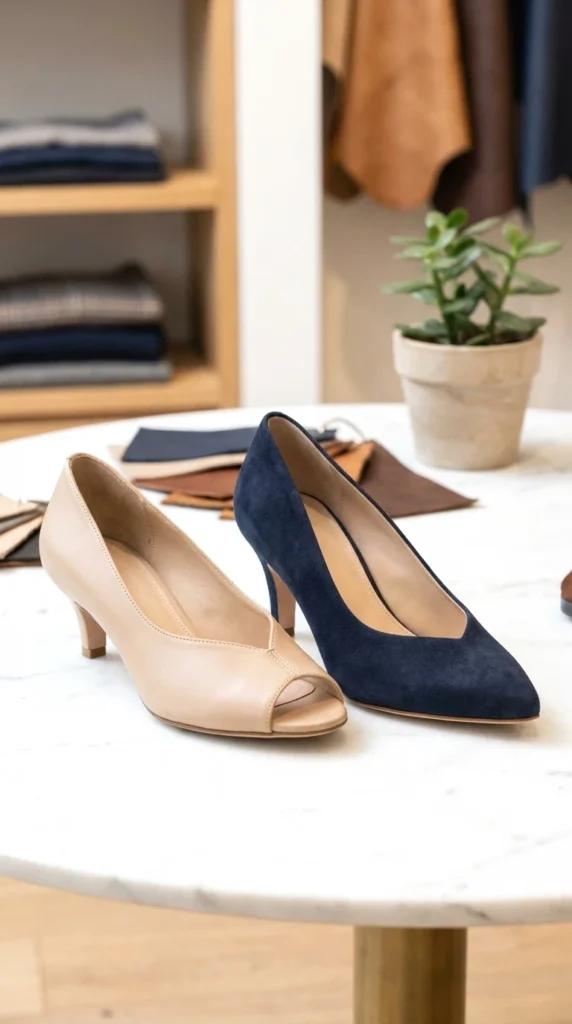
The vamp is the front part of the shoe covering your toes, and a low-cut vamp exposes more of your foot’s arch, adding visual length before the heel even enters the picture. A high, closed vamp does the reverse — it truncates your foot and can make a 3-inch heel look shorter than it is. Look for shoes where the vamp sits closer to the base of your toes rather than climbing up over the top of your foot.
Try a Kitten Heel for All-Day Elongation Without Height

Somewhere between 1.5 and 2.5 inches, the kitten heel gives you a slight lift and a narrow silhouette without the balance trade-off of a taller heel. It works especially well with cropped pants and midi skirts, where too much height competes with the hemline instead of complementing it. Slip on a pair and walk the length of a room — you’ll notice you can move at a normal pace, which matters more than people admit when comparing heel styles.
Save Platforms and Stacked Heels for Wide-Leg Pants Only

A platform sole adds height at the front of the foot too, which cancels out much of the arch that makes a heel elongating in the first place. On their own, they can shorten your visible leg. Paired with wide-leg or flare pants that skim the floor, though, the extra height stays hidden and only the length shows. Save platforms for these specific silhouettes, and skip them with cropped or fitted styles where the sole is visible.
Walk the Store Aisle Before You Commit

Numbers on a box don’t tell you how a shoe actually sits on your foot. Before buying, walk the full length of the aisle, not just a few steps near the mirror. Pay attention to three things:
- Does your heel slip at the back?
- Does the arch support hit where your foot actually arches?
- Can you walk at your normal pace, not a careful shuffle?
A shoe that fails any of these in the store will fail worse after a full day out.
Build Your Petite Heel Wardrobe in Three Heights

Rather than hunting for one perfect shoe, aim for three go-to heights: a kitten heel (1.5-2.5″) for long days, a mid-range pair (3-3.5″) for work and dinners, and one statement pair (3.5″+) for occasions where you’re sitting more than walking. This covers nearly every situation without forcing one shoe to do a job it wasn’t built for.
Height past 3.5 inches often changes your posture and gait more than your visible leg length. The sweet spot does more work than extreme height.
The heel gets all the attention, but the front of the shoe changes the leg line just as much.
This combination shows the thick sole and shortens the leg instead of lengthening it.
A shoe that feels fine standing still can fail completely after ten minutes of real walking.
One shoe can’t cover long workdays, dinners, and special events equally well.
Most petite frames see the best elongating effect between 3 and 3.5 inches, though a kitten heel around 2 inches works well for all-day wear.
Wedges distribute height across the whole sole, so they read shorter than a traditional heel of the same measurement. Treat a 3-inch wedge more like a 2-inch heel.
A strap that sits right at the ankle bone can visually cut the leg. Straps that sit lower, closer to the shoe itself, avoid this issue.
Yes, especially pointed-toe flats with a low vamp, which mimic some of the elongating effect of a heel without the height.
- Measure inseam-to-height ratio
- Rule out under 2 inches
- Test 3-3.5 inch sweet spot
- Match heel shape to leg line
- Check vamp height
- Try a kitten heel option
- Save platforms for wide-leg pants
- Walk the aisle before buying
- Build a three-height wardrobe
Conclusion
You now know exactly where your heel range lives, and why. No more grabbing whatever’s on the shelf and hoping it works. Try on a pair in your 3-3.5 inch sweet spot this week and watch how differently your pants hang.
Next, start building out that three-height wardrobe one pair at a time — you don’t need all three at once.
Save this heel height guide petite pin now so you have it the next time you’re shoe shopping.